
Key takeaways
Pick a call answering service that books a real calendar event with an arrival window, a length and an address, transfers emergencies before taking an address, and bills in a way that fits your call lengths. Prove it before you pay: run your own test calls and check the calendar for the right time and address.
- CallBooking.ai starts at $149 a month with 40 billable calls included, then $3 for each additional billable call, invoiced after the month ends. The base fee is the same in a burst-pipe week; the bill is not capped.
- CallBooking.ai's emergency hand-off is a blind transfer to the on-call number you configure, so it is never a promise that someone picked up. Make sure that number is one you will answer.
- CallBooking.ai writes bookings to a Google, iCloud or other CalDAV calendar you connect, and does not write jobs into Jobber, ServiceTitan, Housecall Pro or FieldEdge, so say so at signup if you run one.
- Every greeting says it is an AI assistant and that the call is recorded. That is built into the code rather than being a setting, so it cannot be switched off.
What a call answering service for plumbers actually does
A call answering service for plumbers answers when you cannot, asks what a plumbing shop needs asked, books the visit, and records what happened. Most callers with a leak do not leave a voicemail. They hang up and dial the next plumber on the list, which is the whole problem being solved.
Answering is a real pickup rather than a callback message. Intake is the name, the address and the problem. Booking is putting the visit into an arrival window you actually have open. Forwarding is knowing which calls should interrupt you mid-job.
A human receptionist or an AI
Human services like Ruby Receptionists staff real people who answer calls, take messages, book appointments and follow your call-handling instructions rather than a fixed script. AI services answer instantly, around the clock, and can write straight into a connected calendar.
How should you compare the pricing?
Per-minute billing charges for operator time on the line, usually rounded up to the next full minute, which suits long intake calls and punishes short ones. Per-call billing charges the same whether a caller hangs up after twenty seconds or talks for ten minutes. A monthly bundle gives you a block of included calls or minutes, so the base cost stays predictable.
Ruby bills against a monthly bundle of receptionist minutes, with plans starting at $250 a month for 50 minutes, billed in 60-second increments and rounded up, so even a ten-second call costs $5. Not every answering service works this way; some bill per call instead.
CallBooking.ai starts at $149 a month with 40 billable calls included and $3 for each additional billable call. Additional calls are invoiced in arrears after the month ends rather than charged automatically to a card. Confirm the wording in your own written order form, because that signed agreement is what governs.
Overflow, after-hours, or full-time?
Overflow means the service picks up when you do not take the call. The threshold is a timeout rather than a fixed number of rings; answering services commonly set it around three to five rings, and CallBooking.ai sets it as a ring time in seconds, anywhere from 5 to 60, agreed with you at setup.
After-hours coverage is where a one-truck shop recovers the most booked jobs per dollar, because a burst pipe does not wait until morning and after-hours callers go to whoever picks up first. Full-time answering makes sense once you are losing jobs you could have taken.
What should a plumbing answering service ask?
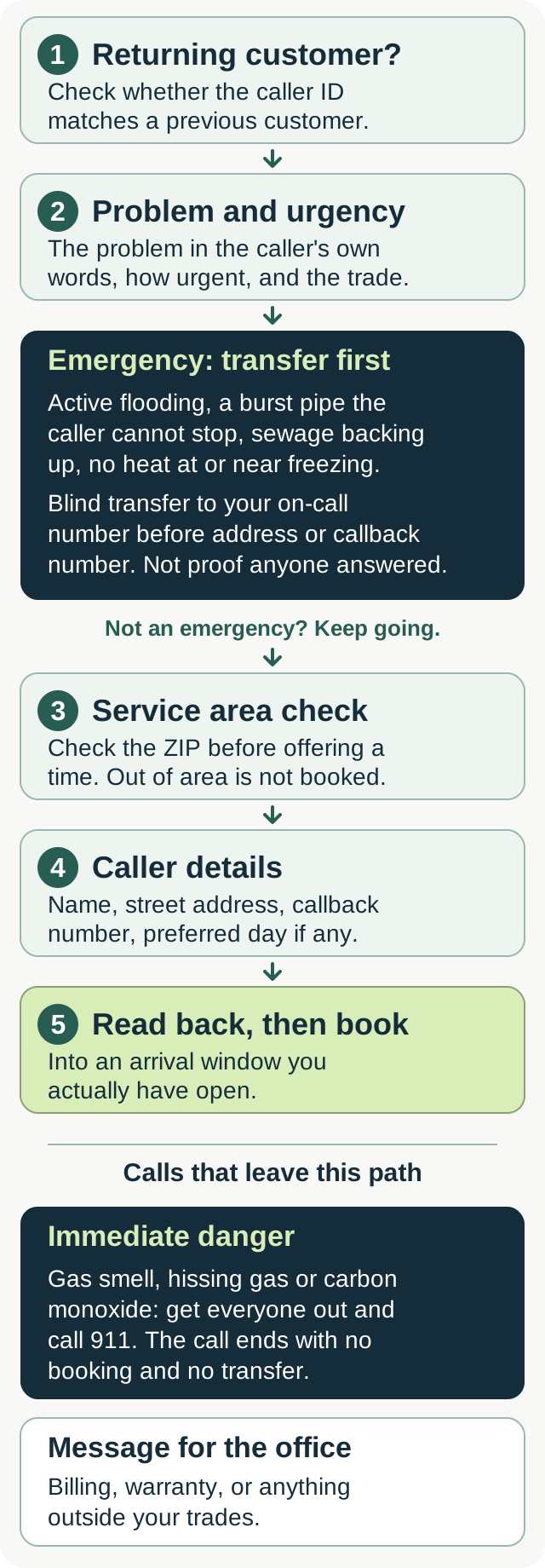
Here is what the CallBooking.ai assistant actually collects, in order: whether the caller ID matches a previous customer, the problem in the caller's own words, how urgent it is, the trade, and the ZIP, which it checks against your service area before offering any time. Then the caller's full name, the street address, a best callback number, optionally a preferred day, and a read-back before it books.
Two things the CallBooking.ai assistant does not ask, and which you should assume no vendor does until you have seen it: consent to send text updates, and whether an adult will be at the property. Neither exists in this product today.
The CallBooking.ai assistant also never quotes a price, not a range and not a service-call fee, never diagnoses a problem or suggests a fix, and cannot reschedule or cancel an existing appointment. Billing questions, warranty questions and anything outside your trades become a message for the office.
What happens on an emergency call
On a call the CallBooking.ai assistant judges to be an emergency, such as active flooding, a burst pipe the caller cannot stop, sewage backing up into the house, or no heat at or near freezing, the assistant stops and transfers before collecting an address or a callback number. It is a blind transfer to the on-call number you configured, so it does not wait to hear whether a person picks up and it is never a confirmation that one did.
Where there is immediate danger, such as a gas smell, hissing gas or carbon monoxide, the CallBooking.ai assistant tells the caller to get everyone out and call 911, then ends the call without booking or transferring.
Booking into a calendar, not just saying "booked"
The test that separates a real booking from a nice voice is whether a calendar event appears, with a length, an arrival window and an address. The Google Calendar API guide to creating events shows events created programmatically with start and end times, a description and a location, so there is no technical excuse for a transcript email instead.
CallBooking.ai writes to a Google, iCloud or other CalDAV calendar that you connect, with the arrival window as the event's start and end time. The connection has to be selected and pass a test booking before it is used. If you run on paper or a spreadsheet, nothing can write to that, so the booking lives in CallBooking.ai's own schedule and you read it in the dashboard.
CallBooking.ai does not integrate with Jobber, ServiceTitan, Housecall Pro or FieldEdge. Writing jobs into field-service software is deliberately outside what this product does, so say so at signup if you run one.
How do you test a service before committing?
Run your own calls before you pay anyone. Book a job, reschedule one, ask for a time when no window is open, change your mind mid-call, ask for a price over the phone, and hang up mid-sentence. Then read what the system recorded. The only proof that matters is a calendar event with the right time and the right address.
With CallBooking.ai, before you pay, you take part in configured test calls on your own number, with you on the call, and you accept five things in writing: that a suitable call books a real arrival window, that the calendar connection verifies and writes a real test booking, that an out-of-area ZIP is declined by your rules, that a callback message is captured and relayed, and that the approved recording disclosure is heard in the opening.
Where CallBooking.ai falls short
The 40 billable calls on the entry plan may not cover a burst-pipe season spike, and each call past that is $3. It does not dispatch crews, quote prices, diagnose problems, or write into field-service software.
CallBooking.ai onboards a limited number of businesses at a time, so availability depends on capacity rather than on where you are based. The area you serve your own customers in is configured separately from that. If you want a human voice for sensitive calls, Smith.ai or Ruby fit that better.
Glossary
A billable call is a call answered on your forwarded line that lasts at least 60 seconds. Shorter calls and hang-ups are not billed and do not count against your plan's included calls.
An arrival window is the span of time a visit is booked into, such as 8am to noon, rather than a fixed start time. Home service work is scheduled this way because travel and job length vary.
A blind transfer hands the call to another number without waiting to hear whether anyone picks up. It is an attempt to reach a person, never a confirmation that one answered.
A service-area check confirms the caller's ZIP is inside the area you gave us before any time is offered. A caller outside it is not booked.
CalDAV is the open standard for reading and writing calendar events over the internet, published by the IETF as RFC 4791, Calendaring Extensions to WebDAV. It is how a booking reaches an iCloud or other non-Google calendar, and it needs write access rather than a read-only subscription.
Questions about answering services for plumbers
Will callers know they are talking to an AI?
With CallBooking.ai, yes, always. Every greeting identifies the assistant as an AI assistant before it collects anything, and then says the call is recorded. That is built into the greeting in code rather than being a setting, so a business cannot switch it off and editing the business greeting does not remove it. Other vendors differ, so ask.
Is CallBooking.ai fair for a one-truck plumbing shop?
Whether CallBooking.ai is fair for a one-truck plumbing shop depends on your ticket size. The entry plan is $149 a month for 40 billable calls and charges $3 for each additional one, invoiced after the month ends; the larger plans include more calls at a lower additional rate. Compare those numbers against a per-minute bundle, where a ten-second call can still cost a full minute.
Do I need a separate electrician call answering service?
Not a separate service, but different triage. The intake is the same: address, callback number, arrival window. What changes is that a sparking panel or a burning smell should reach a person fast rather than get an automated answer.