
Key takeaways
A call forwarding service sends calls from your existing business number to another phone or an answering service, so you keep the number customers dial. Carrier forwarding can be enough when someone can pick up at that destination. If you're on the job or it's after hours and nobody can, pair forwarding with an answering service.
Check your plan before treating carrier forwarding as free, because forwarded calls can still use minutes or incur usage charges. VoIP services offer more routing options, though the features and charges depend on the plan.
Before choosing an answering service, confirm what it can book, which questions it can answer, and what happens when the caller needs you.
Keep your existing number and use your carrier's instructions for the forwarding mode you want. Run five test calls before relying on the setup. Include an after-hours call and check that a test booking reaches the right calendar.
Glossary
Call forwarding sends an incoming call from one phone number to another.
Unconditional forwarding sends every incoming call to the number you choose.
Conditional forwarding sends calls elsewhere under certain conditions, such as when your line is busy or you don't answer.
VoIP means Voice over Internet Protocol, a way to make and receive calls over an internet connection.
The destination number is the number that receives a forwarded call. It might belong to your cell phone, another technician, or an answering service.
What is a call forwarding service for small business, and how does it work?
A call forwarding service routes an incoming call to your cell, another technician's phone, or a service that answers when you can't. You keep your existing number. What changes is where the call lands.
The caller dials your usual business number. Your carrier or VoIP provider redirects the call to the destination you've set. Whoever answers at that destination handles the conversation.
You can forward every call or use conditional forwarding for busy or unanswered calls. The options, setup steps, and charges depend on your carrier and line. Carrier instructions distinguish between these forwarding modes.
When is free call forwarding enough for your business?
Basic forwarding works when calls are few and you can usually pick up at the destination. If you get two or three calls a day, mostly before 5 PM, forwarding to a phone you carry between jobs might be enough. Check when you actually miss calls.
First, check the cost. A carrier may include forwarding in your plan while still applying usage charges. Verizon, for example, says there is no monthly fee on most plans, with airtime billed according to your plan. Its forwarding FAQ explains the charges.
Google Voice also has a no-charge personal plan for eligible users in the US. Its features differ from paid business plans, so check Google's plan comparison before choosing it for your business number.
If you're under a sink and can't answer your cell, sending another call to it won't solve the problem. You need a destination where someone can respond, or a callback process that fits how quickly your customers need help.
How does VoIP call forwarding differ from traditional forwarding?
Traditional carrier forwarding commonly sends calls from one number to another. You turn it on through your carrier's settings or a dialing code, then choose when it should apply.
VoIP services can add routing by time of day, simultaneous ringing across phones, and voicemail transcription. Check which features are included in the plan you're considering. Google's no-charge Voice plan, for example, doesn't include the same scheduling controls as its business plans. Google lists those differences in its subscription comparison.
For a small team, simultaneous ring gives another technician a chance to answer. Scheduled routing can send after-hours calls to a different destination. Those rules help only when the destination is set up to handle the call.
Voicemail transcription lets you read a message between jobs. Someone still needs to follow up.
With Google Voice, linked-number forwarding sends calls made to your Voice number to a linked phone. Adding your current business number as a linked phone doesn't send calls to that number into Voice. That requires a separate forwarding setup with your carrier. Google explains how linked numbers work.
When should you pair forwarding with an answering service?
Pair forwarding with an answering service when you can't safely answer on the job, when after-hours inquiries need a response, or when a callback several hours later is too late for the caller.
Consider a burst-pipe call at 9 PM. Forwarding it to an unattended phone leaves the caller waiting for a response. An answering service can ask about the problem and follow the booking or on-call rules you've agreed with it. Whether you can attend still depends on your availability.
Be specific about what the service should do. Some calls are suitable for a booked visit. Others need a callback or a transfer to the person on call. Test each outcome you plan to use.
What does business call forwarding cost?
Carrier forwarding
Check whether forwarding is included in your plan and whether forwarded calls use minutes or incur other charges. A feature with no monthly fee can still produce usage costs.
VoIP subscriptions and per-minute charges
VoIP pricing varies. Some services charge a subscription with included calling; others charge for usage. Compare the whole plan, including the routing features you need.
Twilio is an example of usage-based pricing. Forwarding a call to another phone creates an incoming connection and an outgoing connection, and Twilio bills both by the minute. Looking only at its inbound rate understates the forwarding cost.
Answering services
Answering services can charge by the minute, call, or monthly allowance. Read how the provider counts usage and what happens when you exceed the allowance.
CallBooking.ai's plan starts at $149 per calendar month, with 40, 100 or 200 billable calls included depending on the plan. Additional usage is billed separately.
The cost of missed inquiries
Use your own call log and job records to judge whether paid coverage is worth it.
Look at which inquiries you could have served, how many you recovered through callbacks, and which turned into paid work. Compare that with the cost of answering coverage.
Which features matter for solo operators and small teams?
Solo operators
Check who answers when you're working and after hours. If the service books visits, make sure it uses the arrival windows you offer and puts the booking on a calendar you check.
A callback message needs enough detail for you to respond. Test an out-of-scope question too, so you know what the caller hears when the service needs your judgment.
Small teams
A second truck adds coordination work. You may need simultaneous ring, transfers to the right technician, and a way to see who's already booked. Check what happens when both technicians are on calls or neither can answer.
After-hours coverage still needs its own plan. Decide who is on call and what the answering service should do if that person is unavailable.
Where CallBooking.ai fits
CallBooking.ai handles forwarded calls for home service businesses, checks whether the caller is within your service area, and follows the agreed booking, callback, or configured on-call process. Transfers depend on configuration and team availability.
Calendar booking depends on a supported connection, the right account permissions, and a successful test booking. Google Calendar is one option. Our current setup criteria cover the calendar your business uses.
CallBooking.ai doesn't quote repair prices or diagnose problems. Those questions still need your judgment.
CallBooking.ai takes on a few businesses at a time, because each one is configured and tested with you before it goes live. Each business's caller service area is configured separately. Check the current launch area and service scope.
How do you set up forwarding without changing your number?
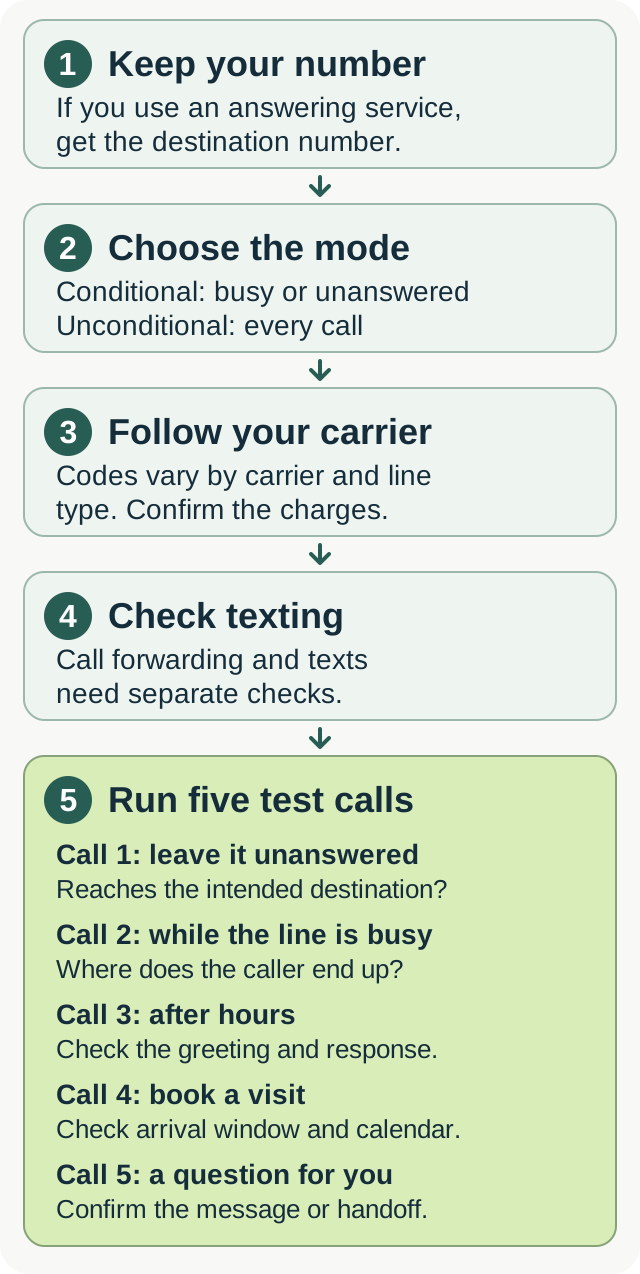
Keep your existing number. If you're using an answering service, get the destination number it assigns you. Then use your carrier's instructions to forward the calls you want it to receive.
Choose the forwarding mode before entering a code. If you want to answer first and send busy or unanswered calls elsewhere, ask for conditional forwarding. If you want every call sent to the service, use unconditional forwarding.
Don't assume *72 means unanswered calls. On Verizon, *72 forwards all calls. Codes vary by carrier and line type, so use the instructions for your own service.
If your business number is on Google Voice, check the proposed connection before choosing an answering service. Google says forwarding Voice calls to an automated system is unsupported.
Before relying on your forwarding setup, confirm the charges and test that calls still reach your advertised number. Check that texting works as expected too. Call forwarding and text-message handling need separate checks.
Test calls before you rely on it
Run five calls from another phone. Leave the first unanswered and check that it reaches the intended destination. Make the second while your business line is busy. Place the third after hours and check the greeting and response.
Use the fourth call to book a visit. Check the arrival window and the event on your calendar. On the fifth, ask a question the service should pass back to you, then confirm that you receive the callback message or configured handoff.
For CallBooking.ai, setup and the agreed call flow are tested before payment and activation. The paid first month has a guarantee on the first monthly base fee, measured from actual activation. Additional usage remains payable.
Which call forwarding service is best for a home service trade?
Start with the calls you need to handle. Basic carrier forwarding can work if another phone and an available person solve the problem. When you need someone to answer after hours or while you're working, compare answering services and their actual booking and handoff rules.
Goodcall and Sameday market to home service businesses. Smith.ai offers AI and human receptionist options, Ruby uses live receptionists, and Trillet offers an AI receptionist. Check the specific plan's capabilities before assuming it handles your scheduling process.
If you're considering CallBooking.ai, confirm launch eligibility, review your service area, and test the calendar connection. Use the same test calls for every provider you compare. Check what was booked, what was passed back to you, and what the caller was told.
FAQ
Can I forward calls to my cell without changing the number customers dial?
Yes. Customers can keep calling your usual business number while forwarding sends the call to your cell. What they hear depends on the destination's greeting and your setup, so test it from another phone.
Does call forwarding use my minutes or cost the caller extra?
Your carrier may count forwarded calls against your minutes or apply usage charges. The caller's charges follow their plan for calling your advertised number. Check your own carrier's terms for the forwarded part of the call.
Can an answering service book straight into Google Calendar?
Some answering services can book straight into Google Calendar, including CallBooking.ai when the connection is supported and tested. Confirm the arrival windows, availability checks, and caller details during setup. Test any rescheduling process you need separately.
What happens if nobody answers a forwarded call?
What happens to an unanswered forwarded call depends on the destination and its rules. The call may reach voicemail or another configured fallback. Test busy and unanswered calls so you know where the caller ends up and whether you receive a message.
Is free forwarding enough for a one-person plumbing business?
Free forwarding can be enough when your plan includes it and you can answer at the destination. If calls still go unanswered while you're working, decide who should handle them and where those calls should be sent.